OIO / DOC-02 · DISPLAY TECH
Display Tech
Circadian performance. No compromise on the picture.
Ready to implement today. OIO brings daytime circadian stimulation and reduced evening melanopic output to displays while preserving the visual experience. Our product roadmap builds on that capability with greater spectral control, higher performance, and more integration options.

Ready Today
The picture you want. The circadian capability you need.
OIO engineers the light spectrum to change the display's circadian signal while preserving the picture. Today's LCD implementation maintains the same D65 white point and color gamut across daytime and evening modes, with no amber tint, contrast loss, resolution penalty, or refresh-rate impact. Reference designs, engineering samples, spectral data, and integration support are available now to qualified partners.
Circadian benefit
A daytime spectrum designed to support alertness and circadian alignment. Reduced melanopic output in the evening to reduce the display’s stimulation of the circadian system. Spectral control follows the rhythm of the day.
Uncompromised picture
Keep the image experience people expect. The available LCD design preserves D65 white and more than 95% sRGB coverage in both modes, with no visible color shift between day and evening.
Ready to integrate
Start with an available design that retains the standard LCD panel. OIO provides the spectral engineering, reference hardware, and integration support to bring circadian capability into your product.
Product Roadmap
Ready today. More capability with every generation.
Today's implementation delivers the core promise: circadian spectral control with an uncompromised picture. The roadmap builds from this foundation. Additional spectral channels provide more freedom to optimize biological output and color together. As components, controls, and manufacturing mature, that freedom creates opportunities to improve performance and reduce or eliminate remaining engineering trade-offs across more display architectures.
Today · Available to implement
Two-channel LCD
Deliver circadian capability today with engineered daytime and evening spectra and a standard LCD panel. MAXBLUE and ZEROBLUE preserve the picture as the biological signal changes.
The foundation: circadian control, preserved image quality, practical integration.
Next · In development
Multi-channel & mini-LED
Build on today’s capability with additional spectral channels, expanded color performance, and finer circadian tuning. The roadmap includes mini-LED and local-dimming integration for more advanced backlight architectures.
The gain: more control over spectrum, color, and local dimming together.
Future · Research & development
Multiprimary emissive
Extend spectral control into the pixel with additional emissive primaries in OLED and microLED. This roadmap direction brings the same visual and circadian design principles to displays that generate their own light.
The gain: native spectral control across a broader range of displays.
Start now. Build forward.
Choose the architecture that fits your product's performance, integration, and maturity requirements. Implement today's capability and plan the next generation with OIO. Qualified partners can explore the detailed product roadmap alongside reference hardware and spectral performance data.
IP Origin
From foundational LED science to circadian display
OIO builds on the Korrus IP portfolio, including Soraa, the LED company co-founded by Nobel laureate Dr. Shuji Nakamura. His foundational work on gallium nitride and the blue LED established the platform behind OIO across spectral engineering, phosphor design, and circadian-tuned product IP for lighting and displays.
Explore the available LCD reference designTwo-channel architecture, MAXBLUE and ZEROBLUE LEDs, and front-of-screen specifications.
LCD Reference Design
Inside the two-channel LCD reference design
This implementation replaces the conventional single-spectrum backlight with a 2-channel LED architecture. Each channel is spectrally engineered: one optimized for daytime biological stimulation, one for circadian safety in the evening. A real-time spectral engine blends the two dynamically, driven by time of day or user preference. The LCD panel itself requires no modification.
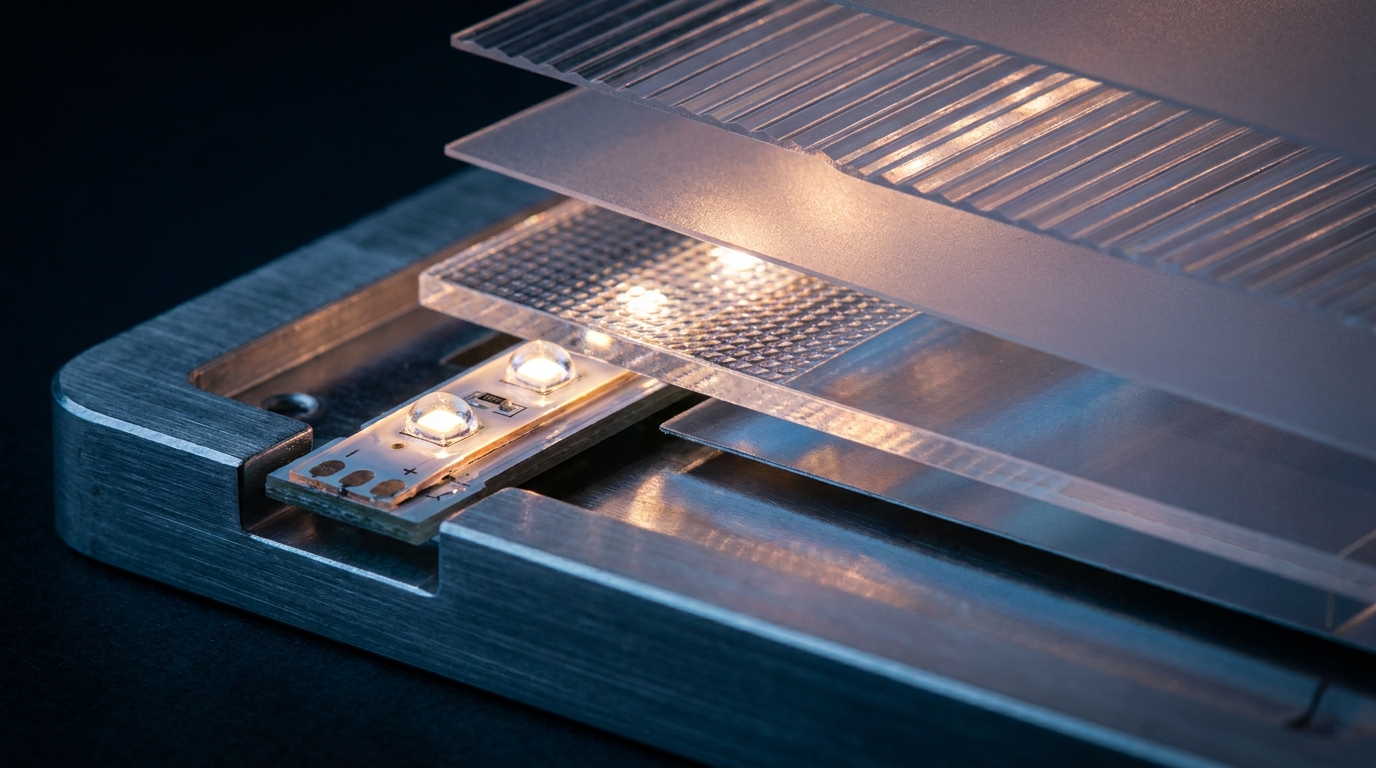
Channel 1 · Daytime
Full-spectrum backlight with elevated melanopic content. Tuned to support alertness, mood, and circadian entrainment during working hours.
Channel 2 · Evening
Spectrally engineered to minimize melanopic stimulation while preserving the same D65 white point and color gamut. Melatonin can rise naturally.
LCD Panel · Unchanged
Standard LCD panel. Same supply chain, same manufacturing process, same cost structure. The circadian capability lives entirely in the backlight.
Reference Design LEDs
ZEROBLUE and MAXBLUE
In this reference design, the two channels are realized by two purpose-engineered OIO LEDs in matched edge-lit packages. They share white point and color gamut, so the visual output is indistinguishable across modes. Their spectral structure is engineered for opposite biological intent.
Daytime
MAXBLUE
High-melanopic alertness backlight. Elevated short-wavelength output in the 440–495 nm band drives circadian entrainment and supports focus and alertness during active hours.
Evening
ZEROBLUE
Circadian-safe evening backlight. The 440–495 nm melanopic band is suppressed while full-gamut color is preserved, reducing sleep-disruptive impact without amber tinting or image degradation.
Why this is technically credible
Most LED suppliers bin only on chromaticity. OIO LEDs are binned on three axes: chromaticity, melanopic DER, and forward voltage. The circadian signal becomes a first-class, lot-controlled product specification, not a marketing claim. Melanopic DER is referenced to CIE S 026, and spectral stability is held within tight bounds over the qualification interval.
Full SPDs, melanopic EDI values, and bin definitions are available to qualified partners.
Front-of-Screen Performance
LCD reference-design performance
In the LCD reference design, both modes maintain the same D65 white point and the same color gamut. There is no amber tint, no contrast loss, no resolution penalty, no refresh-rate impact. The user-facing visual experience is indistinguishable between daytime and evening modes. What changes is what the eye reports to the brain.
Evidence Base
Research behind spectral control
Research on light spectra and circadian biology provides the scientific foundation. OIO connects that foundation to display engineering through spectral characterization and reference hardware. Partners can review front-of-screen performance alongside the published science.
Industrial Deployment
Dow Chemical Study
A controlled study with shift workers at a Dow Chemical facility used OIO spectral technology to support circadian alignment under continuous-operations conditions. Full study design and results are available to qualified partners under NDA.
Published Science
Spectral control and circadian biology
Moore-Ede and colleagues studied how white-light spectra affect melatonin under workplace lighting conditions. Their later scientific consensus report supports lighting that accounts for circadian rhythms. These publications inform the biological principles behind spectral control.
Everyday Benefits
A better display experience, throughout the day
OIO brings circadian intent into the display experience: support the active day, reduce evening stimulation, and preserve the picture through both. Spectral output, brightness, timing, and duration of exposure work together to shape the biological response.
Support the active day
Daytime spectral output is designed to support alertness and circadian alignment while people work, learn, and create.
Reduce evening stimulation
Lower melanopic output reduces the display’s evening circadian stimulus while keeping movies, games, and reading in their intended colors.
Keep the experience
Enjoy the same white point, color gamut, contrast, resolution, and refresh rate across day and evening modes in the available LCD design.
Comparison
How OIO compares to other approaches
Display makers and software vendors have proposed several approaches to address circadian display effects. Most operate downstream of the actual biological signal.
Software night modes / CCT shift
Operate by remapping the color output of the panel. Reduce blue at the cost of amber-tinted, color-degraded images. Cannot independently control melanopic content of the underlying backlight, so the melanopic reduction is limited and comes paired with visual compromise.
Blue-light-blocking films / glasses
Apply a fixed-spectrum filter in front of the eye or screen. Always-on, time-of-day-blind, and visually warm. Useful for some users at some times but cannot deliver high melanopic signal during the day when biology benefits from it.
Lower display brightness
Reduces total light output but does not change the spectral structure. Reduces visibility before it meaningfully reduces melanopic dose, and only in evening conditions.
OIO spectral-control platform
Engineers the light spectrum at its source to deliver circadian control and preserve the picture. Available today in LCD, with a roadmap that adds spectral freedom and extends the capability into more advanced backlights and emissive displays.
Let's talk
Interested in OIO circadian display technology for your product roadmap? Request access and we'll be in touch.
Request access