OIO / DOC-01 · CIRCADIAN RHYTHMS
The Biology
Light is a biological signal
Circadian rhythms govern sleep, alertness, cognition, mood, and metabolism. The spectral content of light, especially from the displays we look at all day, is the single strongest input to that system.
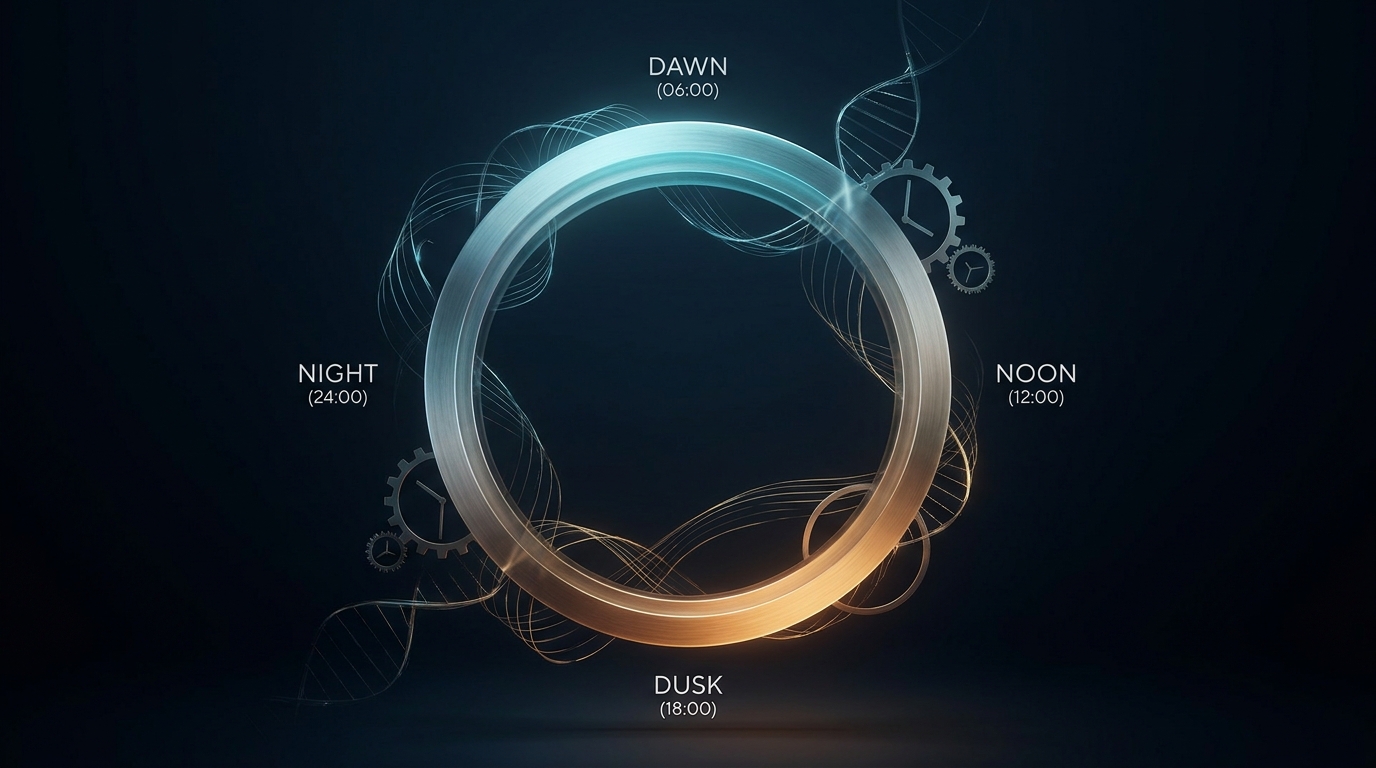
What circadian rhythms are
Every cell in the body runs on a ~24-hour clock. These clocks are coordinated by a master pacemaker in the brain, the suprachiasmatic nucleus (SCN), which itself is synchronized to the external light-dark cycle through specialized photoreceptors in the eye. When that synchronization is intact, biology runs on time: sleep is consolidated, alertness peaks during the day, metabolism cycles appropriately, and hormones are released in the right pattern. When it's disrupted, every one of those systems degrades.
Read the full paper
What Circadian Rhythms Are
Korrus white paper. The biology of the 24-hour clock and why light is its primary input.
How your eyes talk to your brain
In 2002, scientists discovered a new class of photoreceptor in the human retina: intrinsically photosensitive retinal ganglion cells (ipRGCs). These cells measure the spectral content of light and send timing signals directly to the SCN. [Berson et al., 2002; Hattar et al., 2002]
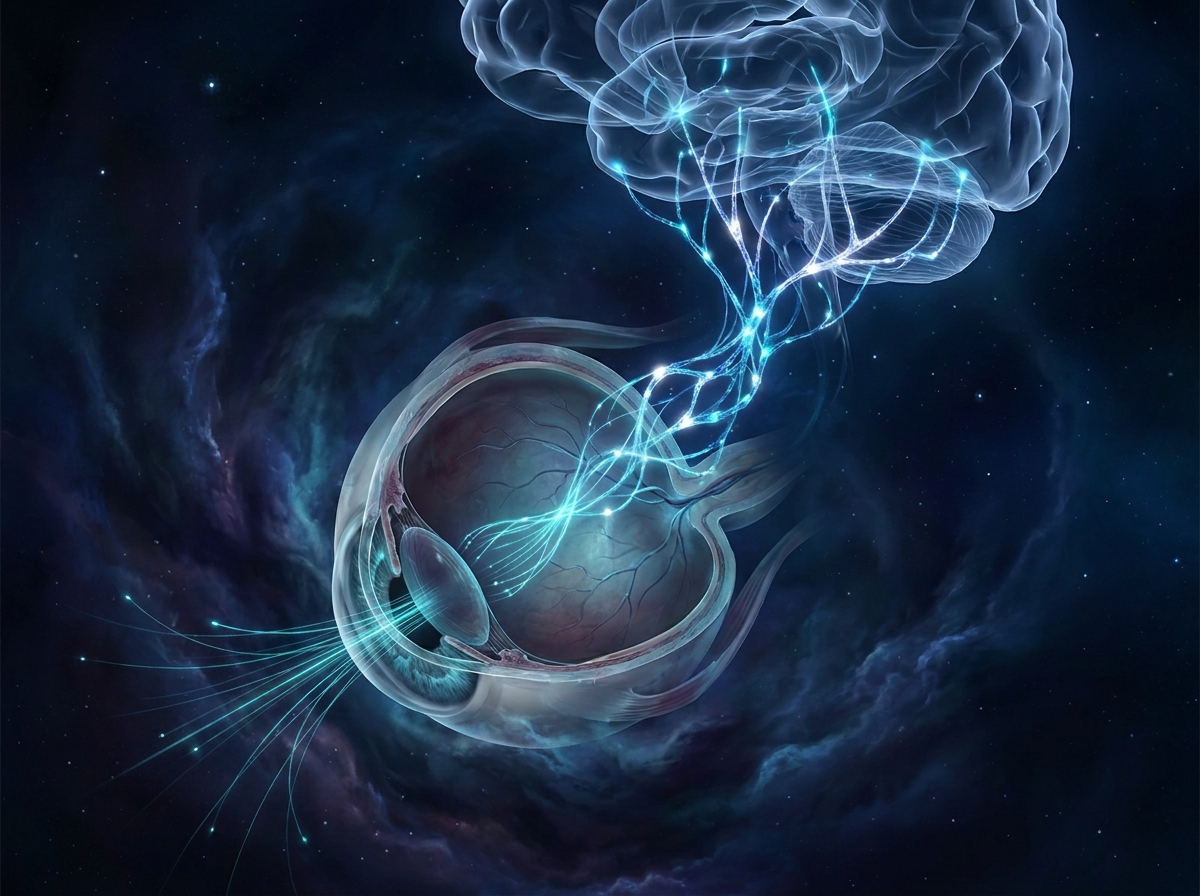
Input
ipRGCs contain melanopsin, a photopigment whose action spectrum peaks at 490 nm per CIE S 026, in the short-wavelength region that conventional displays emit continuously. [Provencio et al., 2000]
Processing
The SCN integrates these signals to synchronize the body's internal clock with the external light-dark cycle. [Brainard et al., 2001; Thapan et al., 2001]
Output
The SCN orchestrates melatonin and cortisol release, body temperature, metabolism, and immune function, all on a ~24-hour cycle. [Gooley et al., 2011]
The role of melatonin
Melatonin is the body's primary signal that it's biologically night. Its evening rise initiates sleep readiness, lowers core body temperature, and triggers a cascade of restorative processes. Short-wavelength light at the wrong time of day suppresses melatonin onset and delays the entire downstream sequence, even when subjective sleepiness is unchanged. [Gooley et al., 2011; Phillips et al., 2019]
When the system is aligned
The research is clear. Proper circadian entrainment improves nearly every measurable aspect of human performance and health.
Improved Sleep Quality
Properly timed light exposure strengthens circadian rhythms, leading to faster sleep onset and more restorative sleep architecture.
Enhanced Alertness
Melanopic-rich light during the day promotes sustained alertness, reduces fatigue, and supports peak cognitive function.
Cognitive Performance
Circadian-aligned individuals demonstrate better memory consolidation, decision-making, and reaction times.
Appetite & Metabolism
Light at biologically inappropriate times modulates leptin and ghrelin, the hormones that regulate hunger and satiety, contributing to metabolic disruption.
When light signals go wrong
Conventional displays deliver the same spectral output at every hour, a biologically inappropriate signal that can desynchronize the circadian system. The short-term effects are immediate; the long-term effects compound across years of exposure.
Disrupted Sleep
Evening screen use suppresses melatonin, delays sleep onset, and reduces sleep quality, with effects lasting into the following morning.
Metabolic Effects
Circadian misalignment is linked to increased risk of metabolic disorders, insulin resistance, and weight gain.
Long-term Health
Chronic circadian disruption is associated with cardiovascular, immune, and mental health impacts across populations.
The role conventional displays play
Standard LCD backlights emit continuous short-wavelength energy concentrated near the melanopic peak. At close range, for hours per day, and often well into the evening, the cumulative melanopic dose from a single workstation can exceed what the circadian system can tolerate without disruption, even at moderate screen brightness. Software dimming and color-temperature shifts mask the problem visually but do not eliminate the underlying spectral signal.
Measurement
Metrics for display circadian impact
The CIE published CIE S 026/E:2018, the system of α-opic quantities including melanopic equivalent daylight (D65) illuminance, mel-EDI, in lux for quantifying the circadian impact of light at the eye. In 2022, Brown et al. published consensus recommendations: ≥250 mel-EDI lux during the day, ≤10 mel-EDI lux in the three hours before bed, ≤1 mel-EDI lux during sleep. Together these form the technical basis for any meaningful circadian display specification. [CIE, 2018; Brown et al., 2022]
CIE S 026/E:2018
Defines the melanopic action spectrum smel(λ) (λmax 490 nm) and the α-opic quantities including mel-DER and mel-EDI that allow direct measurement of a source's circadian-relevant output.
TÜV Rheinland Circadian Friendly
A TÜV Rheinland test mark for displays whose daytime and evening modes meet TÜV's circadian-impact criteria. OIO technology is designed to meet these criteria.
WELL Feature L06
WELL's Visual Lighting Design feature establishes mel-EDI targets for occupied spaces (≥136 mel-EDI lux at the vertical eye plane, ≥4 hours per day, Option 1 of L06 Part 1 in WELL v2). A circadian-aware display contributes directly to that signal.
Let's talk
Interested in OIO circadian display technology for your product roadmap? Request access and we'll be in touch.
Request access